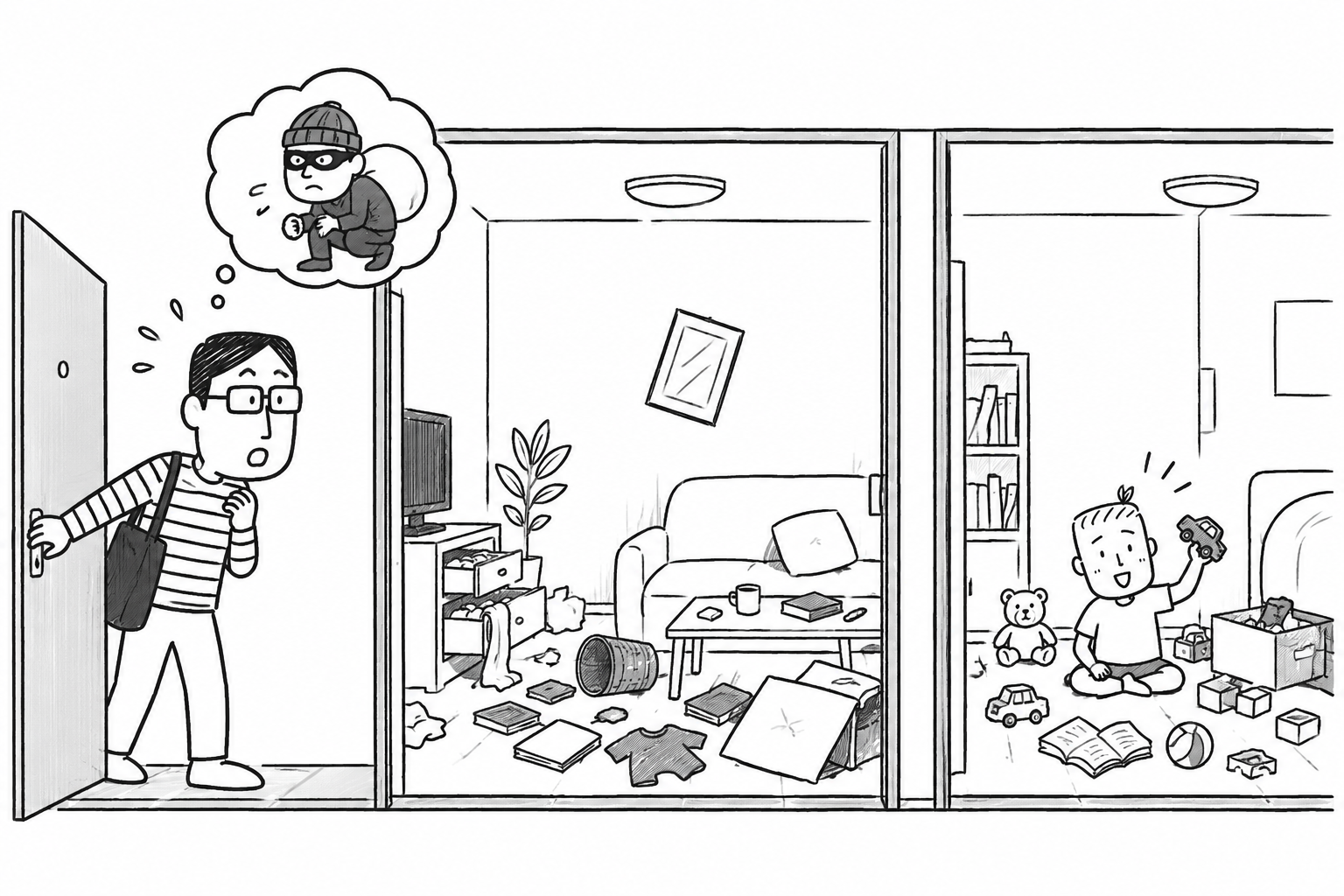
TEKKI-RI てっきり
Meanings
Describes being almost completely convinced that something is true—most often when the assumption later turns out to be wrong.
Examples
The place was such a mess that I was sure a burglar had broken in.
あまりに散らかっていたから、てっきり泥棒が入ったと思った。
You’re so capable that I assumed you had already researched something like that.
君は優秀だから、そんなことはてっきりリサーチ済みだと思ったよ。
You said you were eating out, so I naturally assumed you wouldn’t be eating at home and didn’t cook anything.
外食してくるって言うから、てっきり家で食事はしないと思って、ご飯作ってないわ。
Dogmatic Opinion
TEKKI-RI is typically used after an assumption you made on your own turns out to have been wrong.
You were convinced things were one way, but reality was different: there was no burglary, the research had not been done, or the person who said they were eating out suddenly wants dinner at home.
Although the assumption was your own, you usually feel that you had good grounds for making it. There is often an undertone of self-defense: “Yes, my prediction was wrong—but given the evidence, surely you can see why I thought that.”
That combination of strong conviction, mistaken expectation, and perceived justification is central to TEKKI-RI.
Proximate Expression
no doubt
feel sure
quite certain
Related Words

For Japanese Learners
I was sure, I assumed, I was convinced, and I thought for sure are natural equivalents. “てっきり今日だと思っていた” is “I was sure it was today” or “I thought for sure it was today.” Unlike YAPPA-RI, which often confirms an expectation, TEKKI-RI very often introduces an expectation that proved false.

