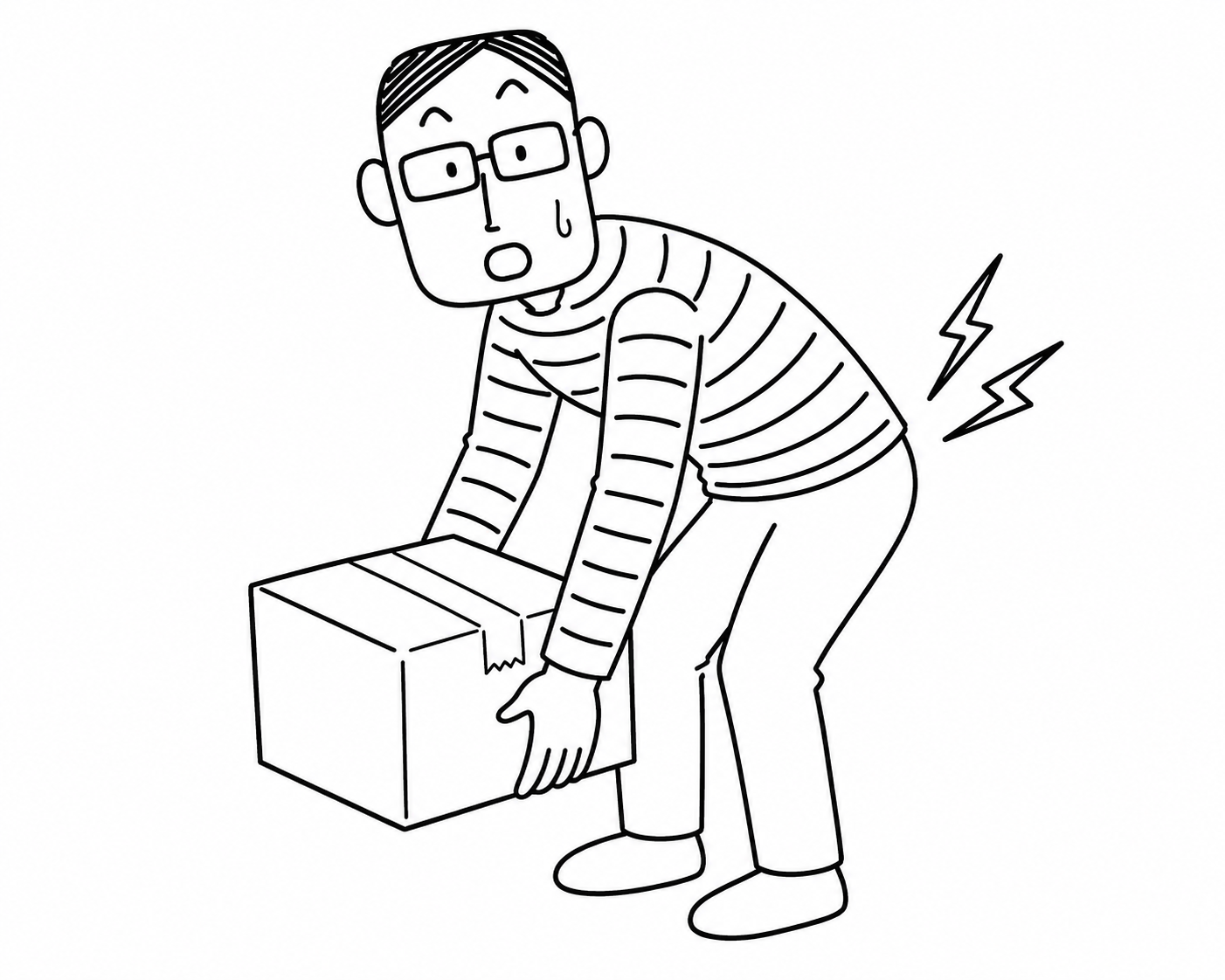
GIKKU-RI ぎっくり
Meanings
1. Same basic sense as GIKURI: being suddenly startled, shaken, or alarmed by something unexpected.
2. Associated with a sudden wrench or painful joint movement; especially familiar in GIKKU-RI GOSHI, an acute lower-back injury.
Examples
1. When my wife said, “You’re hiding money between the pages of your books, aren’t you?” I gave a start.
「本の間にお金隠しているでしょ」と妻に言われて、ぎっくりした。
2. I threw my back out lifting something heavy.
重いものを持ち上げたらぎっくり腰になった。
Dogmatic Opinion
By far the most familiar use is GIKKU-RI GOSHI—sudden acute lower-back pain.
The funny thing is that your back probably does not literally make a sound like “gikkuri.” If anything, I imagine GOKI, GUKI, PIKI, or PAKI.
Senses 1 and 2 may seem unrelated, but they share an unwelcome shock that arrives completely out of the blue. You could almost call it “BIKKURI-goshi”: a surprise attack on your lower back.
GIKKU-RI somehow captures the combination of suddenness, joints, and the unmistakable feeling that something bad has just happened.
Proximate Expression
taken aback
For Japanese Learners
For sense 1, be startled, flinch, or give a start may work. For GIKKU-RI GOSHI, conversational English commonly says throw one’s back out; acute low-back pain or a sudden back strain may be better in more clinical contexts. Translating the imagined sound itself is usually less useful than describing what happened.